
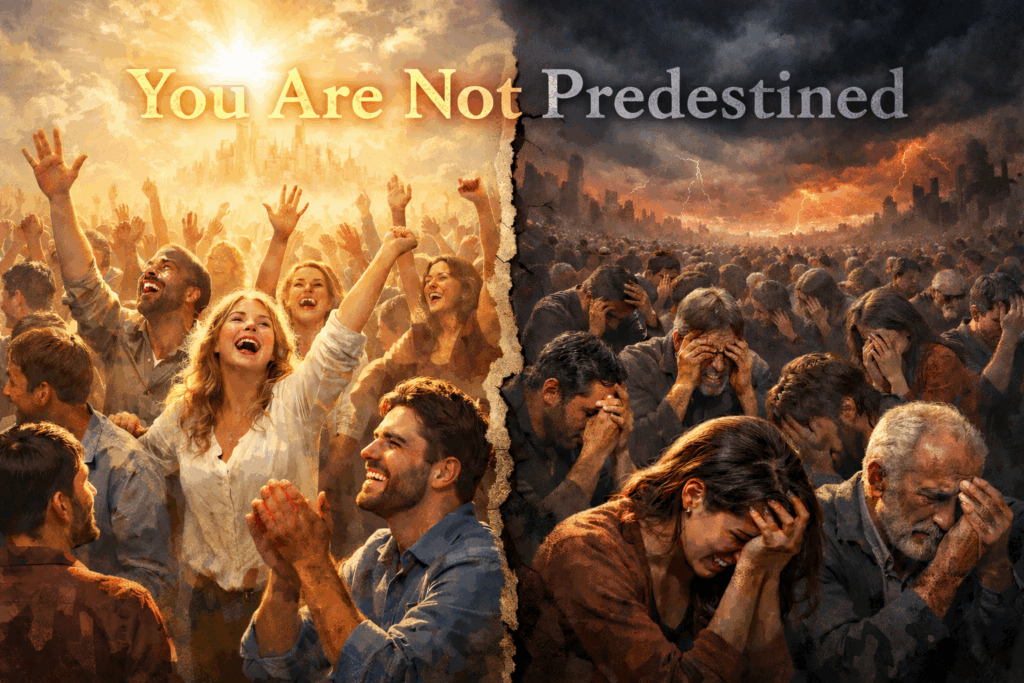
You are not Predestined
The most commonly held views on predestination lead every person to a conclusion which, in the best of its moments, calls into question the certainty of one’s relationship to God. While the major doctrinal families may argue over the metaphysical details when enumerating the tenants of predestination on humanity, they rarely disagree over of the universal application of predestination. God is sovereign, omnipotent, and omniscient. In whatever manner His will manifests its foreknowledge of each of our destinies, it does so universally. The God who knows the end from the beginning already knows the outcome of your life on this earth. That is the only fact-based conclusion about what the Bible teaches on predestination.
Except, it is not true. The Bible’s teaching on predestination is not universal. Its sphere is limited. No one living today lives within that sphere. No person living today has any direct connection to the Bible doctrine of predestination. You and your relationship with God are not predestined. The realization of this truth ranks among the best discoveries you can find on the journey of the maturation of your own faith.
Predestination in the Bible
For even the casual Bible student, the question about the eternal omniscience of God is one that arises early in her studies. If God knows all, how can man have free-will and any choice about his future? One would think then that such a common, important and powerful question would be discussed throughout the Bible. In truth, it discusses the consequences of predestination in countless texts. It would follow then that Bible students should be able to find volumes of material upon which such an important, universal truth is establish.
That being true, how many times does the Bible directly explain the doctrine of predestination? The answer is surprising. The Greek word for predestination, “proorizo,” is in the text six times.
In English translations forms of the word “predestination” appear 4-6 times. The first time it appears it is describing the events culminating in the crucifixion of Jesus (Acts 4:28). In 1 Corinthians 2:7, the second appearance of “proorizo,” the passage is discussing the revelation of the will of God to the apostles and prophets by the Holy Spirit. While both texts fall into the category mentioned above of countless verses which impact the doctrine of predestination, neither of these discusses the effect of predestination on each individual Christian. Direct statements of predestination among the people of God occur in only two texts of the Bible. Those texts are Ephesians 1:5-12 and Romans 8:29-30. Both texts use forms of the word “predestination” twice. So, “predestination” of the disciples of Jesus appears only four times in the Bible.
Even when collecting all six uses of “proorizo” in the New Testament, the doctrine of predestination has a limited emphasis. For example, the New Testament discusses “baptism” around 70 times; and the “mystery” of God (the focus of the 1 Corinthians 2 passage above) appears almost 30 times. The list of doctrines the Bible explains more frequently and thoroughly could be heavily expanded beyond those two examples. When rating the importance of a doctrine by how often it appears in the Bible, predestination is, at best, a minor doctrine.
For a doctrine that has caused and continues to create more questions and confusion among believers, why did the Holy Spirit only discuss “predestination” in two passages in all the epistles of the early church?
Answering that question is done best by examining the texts in which the Holy Spirit does directly address the predestination of Christians. What a Bible student will see is that predestination is not at all a universal doctrine for all disciples of Jesus.
Predestination of “Us”
Ephesians 1:5 seems to make clear the universal application of predestination to all Christians. The text simply reads that God has “predestined us.” The “us” is the group of people that have received “every spiritual blessing” of God (1:3). They were the ones “chosen. . . before the foundation of the world” and they were “holy and blameless.” How many Christians are chosen, spiritually blessed, and blamelessly holy before God? That list of blessings must fall on every Christian, right? If so, then the only proper conclusion is that, yes indeed, every Christian is predestined.
However, is the “us” of Ephesians 1:3 every Christian? To whom is Paul speaking? He is not writing to every Christian in this text. It is seen easily that the text is written to an “us” audience. As modern Bible students, we invariably apply the “us” of passages written to the church to ourselves with few limitations. We see the “us” in these texts and quickly interpret and apply it to all who are in the church. Before you do that; however, you need to see if the “us” of this text has any limitations in it.
Read through the text while paying attention closely to the “us” found in it:
1:3 – Who has blessed “us”
1:4 – Even as he chose “us”
1:4 – That “we” should be holy
1:5 – He predestined “us”
1:6 – He has blessed “us”
1:7 – In him “we” have redemption
1:7 – The forgiveness of “our” trespasses
1:8 – Lavished upon “us”
1:11 – In him “we” have obtained
For the first 11 verses, every pronoun Paul uses to address his audience is a first-person plural pronoun. The pronouns “you” and “they” do not appear in this passage at all. Paul is addressing an audience into which he places himself.
Still, nothing in that list appears to limit the scope of his audience. Which one of those statements would suggest that there exists any exclusion of believers from his writing? The limitation and the exclusive separation from other Christians is found in the following verses. Ephesians 1:12-13 reads:
[S]o that we who were the first to hope in Christ might be to the praise of his glory. In him you also, when you heard the word of truth, the gospel of your salvation, and believed in him, were sealed with the promised Holy Spirit (Ephesians 1:12-13)
Verse 12 continues the “we” appearance of pronouns. Yet, it provides the statement limiting the scope of Paul’s audience in Ephesians 1. The “we/us” of this text is those “who were the first to hope in Christ.” In that statement there is a limitation of order – “first.” There is also a chronological expiration of “we/us” – “were.” The “we” did something first and the perfect participle of the “were” expresses the completion of the act done by the “we/us.” The “we/us” of Ephesians 1 is limited to a certain group of people that had completed an action by the time Ephesians was written. That act was to “hope in Christ.”
So then, who were the first people to hope in Christ? All the “first” ones in Jesus were Jews. They were present in Acts 2 when the gospel was first preached. The gospel was preached first to the Jews (Romans 1:16). Within the plan of God, it was “necessary” that the gospel was preached first to the Jews (Acts 13:46). The “we/us” of Ephesians 1:1-12 is written to those who “first” obeyed the gospel. It was written to Jews.
But the Ephesian church has Gentile converts in it. Are they not included in Paul’s letter to the Ephesians? Yes, they are. They appear in verse 13, “in him you also.” The first occurrence of a plural second-person pronoun appears in verse 13. Additionally, Paul includes the word “also.” The “also” and “you” demands a second group of people are now being addressed. It is here that the Gentiles are included in the text.
However, the topic of predestination is not addressed again in Ephesians. The “we/us” of Ephesians 1:1-12 are those who were predestined. Paul, once he includes the Gentiles, never again mentions predestination. Is it simply implied that the Gentile believers were predestined in the same way that the Jewish Christians were? How could it be any other way? Do not all Gentile Christians receive all the spiritual blessings of Ephesians 1:3; and would not predestination be included in those blessings?
Surely, salvation and all its blessings come upon all Christians. That is Paul’s point in Ephesians. There is unity between Jew and Gentile in the one body of Jesus. All were equally predestined to the blessings of salvation in Jesus. There is no way a simple shift in pronoun usage could exclude the Gentiles from being predestined to salvation to the same degree as the Jews, right?
Well, that is unless predestination is not predestination to salvation.
Predestined Us for Adoption
All major views of predestination discuss the topic based on salvation. The groups argue over the order: Does predestination precede or follow election? They also argue whether predestination is on an individual number or is it a “class” of people. While the arguments are numerous, they are all based on the same belief. Those who are predestined, either individually or in collective groupings, are chosen to be saved or lost.
If predestination is a direct statement of the pre-known state of salvation to which the chosen have been predestined in Ephesians 1:5, “adoption,” must be taken as an exclusive salvific verdict. The second statement in 1:11, “according to his purpose” also must express the meaning of salvation. This approach appears to have a strong textual footing and would comfortably include the Gentiles in the scope of being in the predestined number.
However, this approach has two expositional challenges:
What is the connection between being adopted and being born?
Just as with the discussion of predestination, the discussion of adoption has rare appearances in the New Testament. The Greek word “huiothesia” only occurs in five verses. It is here in Ephesians 1:5. It is found three times between Romans 8:15 and 9:4. The only other time it is found is in Galatians 4:5 which is a closely parallel verse to Romans 8:15.
Remember that “predestination” for Christians appears only in Ephesians 1 and Romans 8. Adoption appears only in Ephesians 1, Romans 8, and a verse, Galatians 4:5, directly tied to Romans 8.
Amazing, is it not? Paul uses the terms “predestination” and “adoption” in the same passages, and it is in those passages only that Paul uses this imagery.
Further, does this imagery fit the more widely used New Testament language of being “born” or “born again?” Being born and being adopted or not the same thing. A baby is first born and then adopted. There is no assembly of these actions that is a singular event. They are two events and those events are easily discerned from each other.
Why then does the Bible use two different events to describe the same event in the life of the predestined? The most common explanation is that being born into Jesus describes an internal change, while being adopted is simply a legal change. Most commonly, both in Reformed and “Free-Will” circles, being born and being adopted happen concurrently. A chosen one is both born and adopted at the same time.
Placing these two actions as concurrent and universal acts received at the point of salvation is precisely what creates the second expositional challenge.
Adoption Belongs to the Jews
If adoption happens to all at conversion, every Gentile Christian is adopted when he is saved. The problem is that the text expressly states that adoption belongs to the Jews.
Interestingly, one common approach to explain why both metaphors are needed in the text is that not only does being “adopted” include the Gentiles, but it also appears in the Bible to reassure Gentiles that they are complete Christians alongside the Jews. David Guzik, author of the Enduring Word Commentary, highlights the Gentile focus on the concept of “adoption:”
“Here may be an important and interesting idea behind the idea of adoption.
- The Roman concept of adoption was strong – and adopted son was just as muchas son as a natural born one.
This may have special relevance to believers from a Gentile background, to assure them that they were in some sense “outsiders,” they were not less in the kingdom in any sense.”[1]
In other words, “adoption” is added to supplement the need of Gentiles to have a full confidence in the validity of their faith. Therefore, adoption is a Gentile-centric concept in Christianity.
The problem is adoption in the biblical text directly excludes the Gentiles. Examine the appearances of adoption in the Bible again:
- Ephesians 1:5 – Adoption is given to the “us” that were the “first to hope in Christ.” No Gentile can be placed within the “first” grouping.
- Romans 8:15 – The saints of this verse have received the “Spirit of adoption.” That receiving of the Holy Spirit produced in them the “firstfruits of the Spirit” (Romans 8:23). Note the appearance of order in connection to adoption. Who received the “firstfruits of the Spirit?” It was the Jews who received the firstfruits (starting in Acts 2) and it was they who were the “first to hope in Christ” (Ephesians 1:5). The Spirit of adoption went to the Jews only.
- Galatians 4:5 – If there is any reason to doubt the explanation just given on Romans 8:15, compare it to this text. The saints in Galatia were also given the Holy Spirit crying “Abba, Father” as mentioned in Romans 8. It was also stated they would be “adopted as sons” (4:5)[2]. Who were those who were adopted? It was they “who were under the law.” It was the Jews again. Adoption, once again, is a Jewish connection.
- Romans 9:4 – If any doubt remains that adoption belongs to the Jews, Romans 9 should settle the issue for every disciplined Bible student: “They are Israelites, and to them belong the adoption…” Paul states it expressly. Adoption belongs to the Israelites – specifically Israelites “according to the flesh” (9:3). That directly and wholly excludes the Gentiles.
This foundational “predestination for adoption” expositional dilemma arises because Bible students read the word “us” in Ephesians 1:5 and cannot consider that “they” might not be included in the “us.” The solution is to remove the modern student from the Ephesian letter until that modern student has applied the words of Ephesians 1:5 to the first recipients of the autograph copy that Paul wrote. Leaving Ephesians 1 in the first century reveals the simple truth both on the doctrine of adoption and the doctrine of predestination.
Predestined Those He Foreknew
Neither Ephesians nor Romans state that predestination is fulfilled at the point of salvation. Both texts are looking to the completion of the mystery of God – His eternal purpose. Obviously, the plan of God results in preaching of the gospel to the world and so, salvation to all. However, that is not the focus of either passage.
Look first at Ephesians 1. This text is about the plan of God:
- 1:3 – “Before the foundation of the world”
- 1:5 – “According to the purpose of his will”
- 1:9 – “Making known unto us the mystery of his will”
- 1:9 – “According to his purpose”
- 1:10 – “A plan for the fulness of time”
- 1:10 – “Unite all things in him”
- 1:11 – “According to the purpose of him”
- 1:11 – “According to the counsel of his will”
God predestined His work as to complete the singular purpose of His will at the fulness of time when all things in heaven and in earth were united in Jesus. Paul later states directly what that mystery of unification was:
[H]ow the mystery was made known to me by revelation, as I have written briefly. When you read this, you can perceive my insight into the mystery of Christ, which was not made known to the sons of men in other generations as it has now been revealed to his holy apostles and prophets by the Spirit. This mystery is that the Gentiles are fellow heirs, members of the same body, and partakers of the promise in Christ Jesus through the gospel (Ephesians 3:3-6)
God’s mysterious will was accomplished by unifying Jews and Gentiles together in the church, the body of Jesus. The church of Christ is the completion of the single, predestined, eternal purpose of God.
How does that connect to adoption? The answer goes back to the “first” statements of Ephesians 1 and Romans 8. It was the Jews who first trusted in Christ. It was the Jews who received the firstfruits of the Spirit. Paul preached that it was necessary for that to happen to the Jews first. The Holy Spirit of adoption which belonged to the Jews and the Spirit’s firstfruits fulfilled the sign of their adoption.
But again, why to the Jews and not the Gentiles? Turn back to Romans 8 again. There is one passage on predestination we have not examined. It is Romans 8:29-30:
For those whom he foreknew he also predestined to be conformed to the image of his Son, in order that he might be the firstborn among many brothers. And those whom he predestined he also called, and those whom he called he also justified, and those whom he justified he also glorified.
Those predestined in Romans 8 were foreknown in connection with their being adopted. Can that be only the Jews?
- First, note that 8:29-30 resides between the “firstfruits of the Spirit,” only six verses earlier, and that the adoption belongs to Israelites “according to the flesh,” only a dozen verses later. The better question would be “Where does Paul include the Gentiles between Romans 8:23 and 9:3-4?”
- Second, examine those that God “foreknew.” Again, our tendency as Bible students is to place ourselves immediately into texts about Christians. Has God not foreknown all of us? It is better to delay that question until you know about whom Paul is writing. In Romans, what people did God foreknow? Paul states it directly in 11:1-2:
- “I ask, then, has God rejected his people? By no means! For I myself am an Israelite, a descendant of Abraham, a member of the tribe of Benjamin. God has not rejected his people whom he foreknew. Do you not know what the Scripture says of Elijah, how he appeals to God against Israel?”
- What people did God foreknow that He did not fully reject – to which Paul’s own conversion testified? Israelites, descendants of Abraham. The foreknown people in Romans were Jews.
Pull yourself, a modern 21st century Christian, out of Ephesians 1 and Romans 8-9 and the message of the predestination/adoption passages is clear:
Predestination is Jewish.
Connecting Predestination and Adoption
Here is what we have seen:
- Predestination is for Adoption (Ephesians 1:5)
- Predestination is for those “who first trusted in Christ” (Ephesians 1:11)
- Adoption Belongs to the Jews (Romans 9:4)
- Predestination is for the Foreknown (Romans 8:29)
- Jews were the Foreknown (Romans 11:2)
- No Gentile has ever been One of the Predestined of Romans 8 and Ephesians 1
So then, what is the connection between predestination and adoption and how is it Jewish only?
Mr. Guzik’s conclusion from earlier that adoption was needed for the Gentiles has the right answer, just the wrong premise. His thought was it was the Gentiles that would need a full confidence that they were in full standing with God. In time, they would need exactly what Mr. Guzik is stating. However, that would not arise until the Judaizing teachers’ influence began to divide the church. Before the first Gentile ever entered the church, one group did exist that would have serious questions about their standing. That group needed to know they had been adopted into God’s family.
The adopted group were already part of the chosen, the foreknown, the predestined. Since the days of Abraham, everyone knew what people made up the family of God. Being the seed of Abraham was a birthright. Every Israelite was “predestined” to be in God’s family through Abraham. They were just born into it. From Acts 2 to the conversion of Cornelius in Acts 10, every new Christian had already been born into God’s family long before they were born into the church. They entered God’s family when they were born physically into the world.
Yet, starting in Acts 4, national Jews began to question this new faith among them. The family of Abraham began to question the right of some their family members to “come to dinner” with them. Quickly, by Acts 7-8, they began to put to death these family members who had denied the family name and left Moses for Jesus. You see, they were changing families.
If you happened to be a Jew who was a new Christian and your old family forced you out of the house (Acts 8:1-4) and even threatened your life (Acts 7), what might you need? You would need a new family. You see; by leaving the house of Moses, you just became an orphan with no family.[3] You were not welcome among your Jewish family anymore and, because you were born a Jew, you weren’t going to the Gentiles. Can you imagine questioning your choices? You would certainly call into question your faith and whether God approved of your actions.
If only you could find a new family. Would not being added to a new family make leaving your old family and its devotion to your God so much easier to bear? Think with me for a moment. What is a good word which describes using your first family and then being added to a new family? Oh, how about – “adoption.”
Would it not even be better if you knew that your Father had seen this coming and bringing you into a new family was the best part of His plan all along? Imagine the comfort you would find in knowing that your Father had been preparing from the very start for all this. What was happening to you now was the full mysterious plan that He had spent all his time on. If only there were a word to describe that also. Well, how about His plan to adopt you was “predestined” all along.
Conclusion
This is the connection between predestination and adoption. Jews, alive when Jesus was on the earth, had already been born into the family of God through birth and circumcision. They were then adopted into the body of Jesus. Those were not simultaneous actions. They were two separate events and so have two separate metaphors describing them. No Gentile has ever been in two families of God. Gentiles have only ever been in the church. You are born into the church from being dead in your sins. That is not adoption. First century Jews were born into one family of God and then adopted into another. God’s eternal plan had prepared the way for this one generation of elected, chosen, and predestined people to go from one family to another. They were predestined to adoption, not salvation. They, faithful Jews who accepted Jesus, were never lost. They were never outside of the family of God. No Christian in the church today – either Jew or Gentile – can say that.
We are all born into this family at baptism. We were not predestined for adoption. We are not predestined. We were born directly into the only family God has on this earth – His church. Being born once with no need for an adoption is the powerful blessing every Christian has received ever since the mystery of God was finished. Rejoice in not needing to be predestined.
Wait, if we are born one time into God’s kingdom, what does it mean to be born again? How is that connected to being adopted? That’s a great question – for another article.
[1] David Guzik answering the question “Are We Adopted or Born Again?” (https://enduringword.com/are-we-adopted-or-born-again)
[2] This goes beyond the scope of this article but notice carefully the shift in pronouns between 4:5 and 4:6. It is the “we” who “born under the law” that were “adopted.” That matches the statement of Ephesians 1:1-12. But those who are “sons” in 4:6 changes to “you.” That also follows the pronoun shift in Ephesians 1:13 – to include the Gentiles. Both passages are Jew/Gentile equality arguments. Yet, both directly connect adoption to the “we” Jews and make no statement of adoption to the “you” Gentiles.
[3] The introduction that Jewish followers of Jesus might consider themselves as orphans compared to other Jews is not introduced by Paul. Jesus encouraged His apostles that He, upon leaving, would not leave them as orphans. His promise was to provide the Holy Spirit as evidence of their place in God’s home (John 14:15-18). Note that Paul’s evidence of adoption in Romans, Galatians and Ephesians is also the Holy Spirit (Ephesians 1:13-14; Romans 8:15; Galatians 4:5-6). The Bible never has parallel structures like this on accident. Predestination, adoption, and the prophetic firstfruits of the Holy Spirit are directly and intentionally connected.

Jonathan Jenkins

Gift of the Holy Spirit (Acts – Part 2)
Stated as simply as possible: “The gift of the Holy Spirit is the fulfillment of the promise of the Holy Spirit.” That promise is said to have been responsible for the presence of the Holy Spirit on the day of Pentecost (Acts 2:33). The nature of that promise is explained in the quotation of Joel 2 in Peter’s defense of the apostles’ actions (Acts 2:16-21).

Who Were the Judaizers?
Understanding who the Judaizers were and their connection back to the Pharisees (Acts 15:5) is going to provide great insight into Paul’s use of the word “spirit” in Galatians, Romans, and the rest of his epistles.

Holy Spirit in 1 and 2 Thessalonians
We have seen in previous essays how the spread of the prophetic powers into new fields of preaching was integral to the spread of the church. The Spirit’s powers were essential in Jerusalem, Samaria, with Cornelius, and to defend the work of Paul’s first missionary journey. Is it reasonable to think that the same emphasis about the work of the Holy Spirit would be missing from the first epistle written to one of the first apostolically planted churches among the Gentiles in Europe?
